
Overview
The Interest type setting determines how interest is calculated.
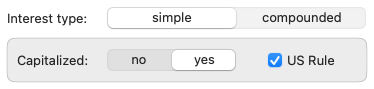
It can calculate simple or compound interest.
Simple interest can be capitalised or not capitalised. If interest is capitalised, you can choose to apply US Rule which prevents interest being charged on interest.
Interest type settings
Simple interest
Interest is never capitalised and added to the balance. The application will keep separate totals and display them in columns for balance due, interest due and total due.
Pure simple interest is most suitable for legal interest calculations, penalty interest, or running accounts where partial payments reduce the principal while interest continues to accrue on the outstanding balance.
For a description of the observable effects of pure simple interest with regular payments, see Reference dates and capitalization.
Capitalized simple interest
Interest is added to the balance at some point in time. The application will keep separate totals and display them in columns for balance due, interest due and total due, and adjust their values when interest is capitalized.
Capitalized simple interest with US Rule
Interest is added to the balance at some point in time. The application will keep separate totals and display them in columns for balance due, interest due and total due, and adjust their values when interest is capitalized.
US Rule prevents interest being calculated on interest. When the payment is insufficient to cover accrued interest, it is kept pending until it can be taken into account.
For a description of how US Rule interacts with reference dates and the conditions that can lead to no capitalization occurring, see Reference dates and capitalization.
Compound interest
Interest is compounded at the selected compounding or periods frequency. As with simple interest, details are provided depending on the selected date interval method.
When date intervals are computed as periods and days, the period anchors (either the item date or a reference date) determine the days and periods fractions that are used in the calculation.
When date intervals are computed as a year fraction, it is calculated from date to date.
Related topics
Interest calculation fundamentals
Reference days and capitalization